— Suppose you find yourself at the start of your affiliate marketing journey, but with all your current experience. Where do you start: SEO, your own buying team, an affiliate program or a different product?
I wouldn’t change anything. We followed a plan we had thought through in advance, and it paid off: first we developed one vertical, then took on the next, then added services, and only after that worked more with the team. I would repeat this route without changes.

When a beginner jumps straight into Nutra or iGaming, where there are tons of bans, they simply can’t get out of the mistakes. It makes more sense to start with something simpler — say, advertising your own product.
— Is there decent training in our field, or do you have to learn everything on your own? How was it for you?
I get this question all the time. I notice that people buy courses en masse and hope that will pull them through. A course, an acquaintance or a relative — any of these can give you a start. But in my view, two things help you stay in the profession.
The first is a fellow professional. You meet, share experience and don’t let each other give up when things get hard. It’s like going to the gym with a partner: your buddy doesn’t have to be stronger than you, the point is that he is there. You’ve learned a new skill — there is someone to share it with. A girlfriend, mom or dad won’t understand your setup, but a colleague in the field will get it right away.
The second is a mentor who will be next to you and teach you on the go. Paid training works here, and so does an exchange: you help with the work and get knowledge in return. Over time, as you grow, the mentor will entrust you with more complex setups and tasks. So a partner sustains motivation, while a mentor provides skills.
There is also a third option — the Arbitrage Up academy. It is a project that grew out of the experience of many buyers, including mine. We have been on the market for several years and have trained thousands of students, many of whom genuinely work in the field. We pay special attention to practice: we provide personal support, a kind of ideal mentor, the one I described above.

Separately, let me talk about a safety net. A setup can stop working at any moment. Yesterday you were making, say, $300 a day, and today the advertiser tells you the product has run out. You’re stuck, with no backup offer to switch to instantly and get back into profit. That’s why you need people around you: a community or a team with whom you can quickly take a new setup into work. Many people lack this, and sooner or later it becomes a problem.
Recently at a conference I became convinced: almost everyone sits in their own corner with their own schemes and shares nothing. With this approach, a team is no use. We do it differently: the team lead is responsible for making sure everyone earns, and it works.
— Which vertical and traffic source did you start with in your first tests? Why that choice?
Our first launches were in microfinance. At that time, everyone was talking about Monobank’s referral program: you get 50 hryvnias if you invite a friend. We thought that instead of sending the link to friends, we could put it into advertising on Google and Facebook.

Before launching, we decided to check everything: two acquaintances signed up via our link so we could see how the crediting works. There were no payouts. We were told that these people already had accounts, and no bonus is paid for those who previously used “Shvydkohroshi.” We saw that the partner operated non-transparently, and we parted ways.
Next we tried other credit services and cash-loan providers, but on both Facebook and Google the result was zero. I decided to dig deeper: in microloans, everything always comes down to tech. You need websites, and then it dawned on me that they had to be catalogues, with ten loan offers on a single page. The essence of the scheme is to get a person to leave applications with all of them and take at least some money. I understood the system, but keeping up with it technically was hard.
So we switched to “white” e-com: laser levels, car mats and the like. It converted well, and we started earning more. Before physical goods and microloans, we had also managed to get into hardcore Nutra. The money was good, but it wore us out. I was struck by how they work there: you haven’t even launched yet, and you’re already banned. It became clear that you can’t manage there without a techie, cloaking and tests, and we went back to physical goods, e-commerce.

— How many hours a day did you work in the early days?
Max and I worked with absolutely insane dedication, at 100%. We picked cafés as our “offices” — “Mister Cat” and “Eurasia,” which was considered elite at the time. We would gather at nine, have coffee, get up to speed and sit until 11 p.m. Every day, including Saturday and Sunday. When we got a real 45-square-meter office, the schedule didn’t change: seven days a week.
— What did you get at the start: profit, loss or zero?
Every setup required testing, investment and drive, just like now. People ask me how I “managed back then.” But essentially nothing has changed since then; only the requirements have gone up: you need strong specialists and quality tools. Facebook banned much more harshly than it does now.
— When you started building a team, how did you structure cooperation with the buyers: salary plus percentage or percentage only?

I could simply hand people money without going into details or counting. I was interested in other metrics, not earnings figures. Of course, I paid the guys. I just wanted to reach another level, so the income back then interested me little. Today, though, our buyers get 35%, 40%, and sometimes 50%.
— Whom would you never take onto the team?

Those who come in thinking not about earning, but about how to save or cut something. This happens often. Someone says: “At my previous place I got 15%.” That shocks me, because with us it’s 35%, 40%, and sometimes 50%.
— Where did the name One Partners come from?
I won’t tell all the details, but the gist is this. I never spent long thinking about names. It has to be convenient and easy to remember. With the affiliate marketing academy, it’s simple: let it be Arbitrage UP. And what should an affiliate program be? The best. So, One Partners.
— Is it hard to run several projects at once? Where are the greatest difficulties?
Many people are interested in this question: focus on one or spread your attention. There is no universal answer: it all depends on the circumstances. You can work either way, but you need balance. You shouldn’t run five projects, one about textiles, another about cars, a third about roads, a fourth about IT. They should be related. When the directions are too different, quality suffers, because every serious project needs someone who lives it, frankly speaking, from morning till night.
Next, everything comes down to the manager. The level of a project equals the level of the person running it: their mind, energy, strength. The link is direct. Once you’ve found or grown such a leader (more often grown), you can move on. A second project makes sense only when the first is already making money. And in general, nothing will work without dedication to the cause.
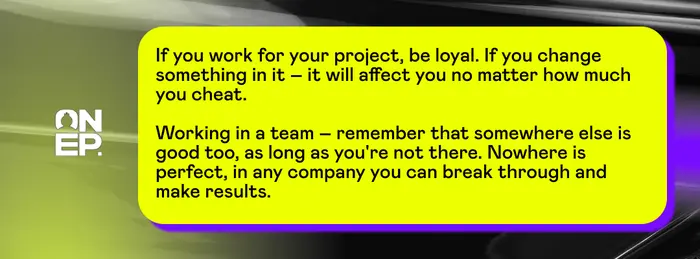
People sometimes come to us saying: “I left there because of this and that.” I ask: maybe you’re just going through a phase and seeing everything in a negative light? You can reach an agreement anywhere — you just need to talk to your manager.
— If not for affiliate marketing, what else would you be doing?
Frankly, once I realized that money can be made, I would most likely have gone into e-commerce. When you have capital, you can create your own brand. But you shouldn’t do it with minimal funds. First, it’s worth getting your hand in on temporary projects: profit there usually comes faster. And it’s better to approach your own brand gradually.
My friends say: “Let’s make branded clothes, sneakers, pens, lighters.” And they start stockpiling all of it. That may be right, or it may not. It’s wrong if you have 300 hryvnias in your pocket. It’s right if you already have at least a minimal structure.
— Do you plan to scale wide or deep?
You need to grow not for the sake of money, but to stay relevant in the market. Sometimes I hear: “My business brings in $20,000 a month; that’s enough for me.” No, my friend, it’s not enough. A business either grows or declines. There’s a joke: you can get into a business, but you can’t get out of it.
— In which three countries would you open offices if you were expanding your staff abroad now? Why?
In Brazil and Portugal, because we have a foothold there. And in Ukraine. The company is going international and will keep growing. And we haven’t even started yet.
— How many people are in the holding now, if it’s not a secret?
In total — 250+. And those who make important decisions number a few dozen.
— How hard was it to resume work after the start of the full-scale war? Did you manage to reach a new level?
At first, of course, work stopped. We could have given it a 100% good boost, but fortunately we quickly pulled together and got our heads in the game. And yes, we did reach a new level.
— Have you ever regretted coming into affiliate marketing?
Never. I searched for a foothold in it for a long time. Seeing that money comes in faster here than in traditional business, I jumped in right away and started working.
— What would you advise yourself at the start, and those who want to build a team?
You have to take risks, otherwise, nothing will work, but not beyond your means. I wouldn’t go to investors; I didn’t use them myself. Yes, I borrowed money for the start, but that’s a different story. I started with $200. Times have changed, so now it’s realistic to start with $600, and many start with sums up to $1,000. Our affiliate program has iGaming offers with favourable numbers and fast payouts: you can withdraw profit, reinvest it and quickly gain momentum.
— Now you have your own affiliate program, buying team and academy. What else do you plan to launch this year?
Right now I have an affiliate program, media buying teams in iGaming, Nutra and Dating, an academy, a shop, a coworking space and an app service. Plus a bit more that I don’t disclose. All in all, a lot. So let the future projects be a surprise for partners.
— Aren’t you planning your own events and conferences?
We’ll see. We organized Traffic Days, and it was a success. Events are, of course, organizational hustle, and they take a lot of effort. If you take something on, it should be something truly high-quality that will “take off.” Ordinary events don’t interest me.
— Can an owner forget about work-life balance?
Unfortunately, apart from work, there is practically no time left for anything.
— Can you save money in a large company? If so, on what?
I’m a manager who starts with a lower salary but with room for growth. Of course, it’s competitive from the start — that isn’t even up for discussion. You can always raise it, but a cut immediately demotivates, and the person may leave. This never happened with my team leads, because at the beginning of building the business we knew how to help each other out: “There was no profit this month, but here’s some money; you have to live on something.” Back then I realized there was no money, but that we had to support each other.
A lot depends on the owner, actually. There are plenty of stingy people on the market, and there is a belief that the boss must earn the most. But a company should invest in its own development: in promotion and in prospects for the team. I could not have launched the affiliate program and the apps, and simply earned for myself. But in these projects, people who have been with the company for a long time will appear, and they will grow into new positions. Truly, we have no so-called “ceiling,” and I am very proud of that.
— Which vertical is the most profitable?

We do marketing, so it’s important for an affiliate marketer to realize that they are actually a marketer. They have to build strategies, run them and optimize them. The “came, jumped in, drove traffic and vanished” scheme doesn’t work. Such buyers are just helpers of the one who runs the traffic.
— How long does it take to become a top specialist?
Six to eight months. With us, assistants grow into team leads in that time. For comparison, people study at university for 3–5 years, and it’s not always clear what comes next. Sometimes people come to us who are ready to work for free for half a year or even a year for the sake of skills. Others last a couple of months and say: “I thought that from the second month I’d already be buying this and that.” People, you want to change your life thanks to affiliate marketing, but you’re not ready to invest time in it. It doesn’t work like that. Don’t reason: “If affiliate marketing gives me money, I’ll be serious; if not, I won’t.” That’s not how it works.
— How can you tell that affiliate marketing isn’t for you?
Most likely when you are weak on creativity.
You look at a joint cream — and you have to understand what it’s made of and how it will hook people. You need to study the geo and region: why people there will buy this cream, what the climate is, what time of year it is, which cities are colder. Don’t overload yourself or spend loads of time on this stage alone, but work it out and make a creative: minimum text, but text that brings a person to the landing page and keeps them there. This takes creativity and flexible thinking.
Those who look for a ready-made setup usually fail, because the idea is someone else’s and they don’t feel it. Say ten people are sitting there, and one gives the rest a setup with 100% ROI — they won’t run it. Why? They don’t understand what exactly they are selling. And you have to understand.
My first successful setup was on sneakers. I felt it: I went to the store, tried them on, and they told me about the model and its history. Then I decided to “borrow” a setup from an acquaintance — Pioneer tape recorders — and it didn’t work for me. Later the acquaintance explained: I hadn’t written anything about these tape recorders, hadn’t highlighted the main and strongest points. I put in a banal description that is everywhere. That’s when I finally realized: you have to understand what you’re selling.
— For what amount are you ready to sell the company?
Of course, for none. We don’t do that.
— Is it necessary to run Facebook traffic yourself before opening a shop?
Preferably, but not necessarily. If you worked as an assistant in affiliate marketing and then opened your own shop, you need to stay on top of things constantly. Running traffic yourself is a temporary solution. Buyers used to take setup and run them from home. Now that won’t work: you have to be up to date with changes all the time.

— How deeply are you involved in operations? Could the holding keep running if you went on vacation for a month?
I think I could even go on vacation for a year. This became clear when I realized: you shouldn’t wait for super-managers who will come and change everything. We started raising people in the team who can run a project without me.
— What are the prospects for students of our academy living in Europe? What would you advise them?
In general, our affiliate program needs affiliates and managers who will travel to conferences and be constantly reachable. We plan to open the holding’s partner offices in Europe, most likely in Warsaw or Krakow. For now, the best thing is to work in the company and show that you are a sensible, open person.
Working remotely often means “buying a pig in a poke,” so we are cautious. Those in the office we can see, they work, everything is transparent, and their prospects are real. We have remote employees too, but there are difficulties with them: some are looking for another job in parallel, and some lack focus. When we open an office in Europe, those working remotely will be able to move there on new terms.
— Can someone whose only experience is “first-bills” launches on Facebook get into your team?
You don’t need many skills here. We have a negative attitude toward it. As do many other teams, actually. It’s better to forget that you did first billing and not tell anyone about it. Get a job as a farmer or a buyer’s assistant and show results. Don’t inflate expectations, but achieve success inside the company. If someone wrote to me with such a request, I would take the person without knowing about their past. There is a lot of first billing now, and I don’t trust it because it’s irrelevant experience. It’s better to build up your skills and join a team for real campaigns.